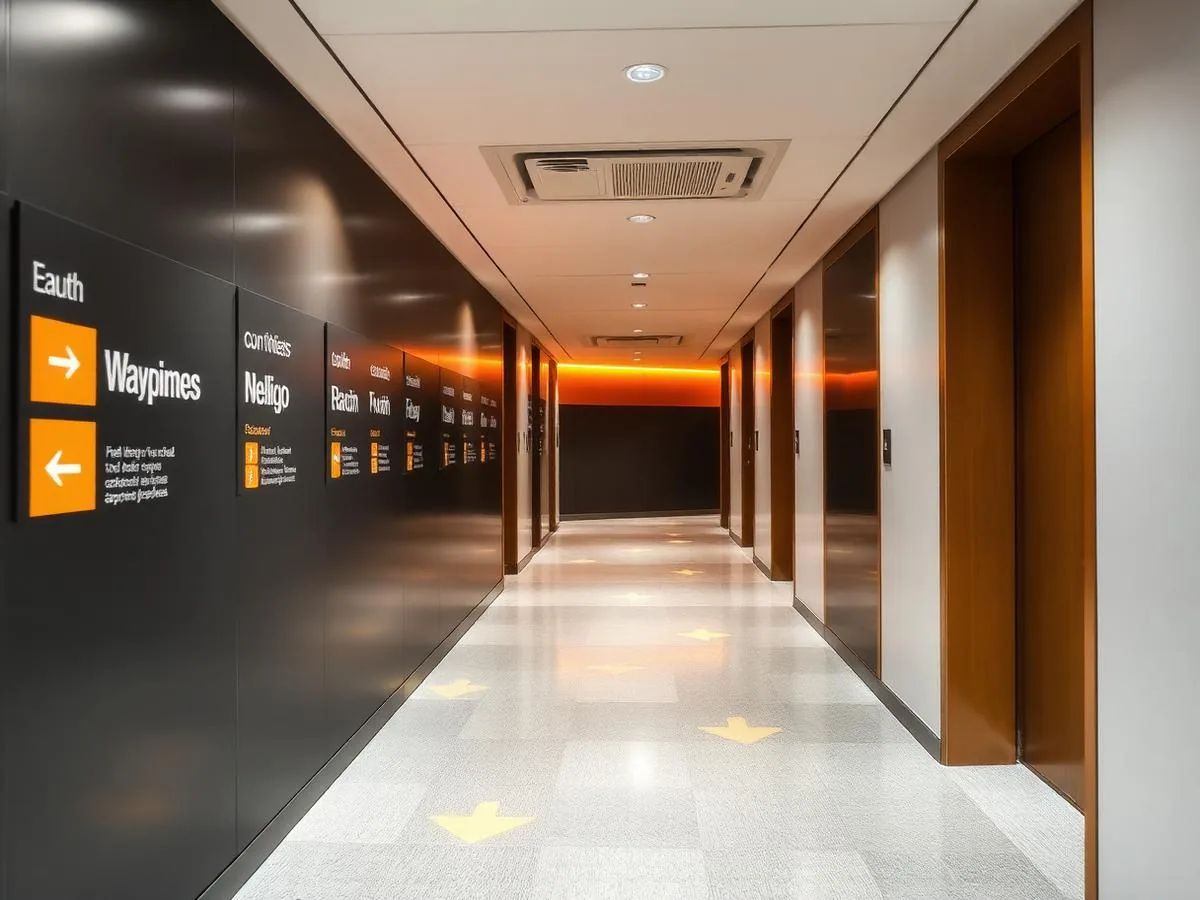
Wayfinding is what stops a visitor standing in a lobby wondering where to go. Done properly it is a system — consistent typography, colour and hierarchy carried from the car park to the meeting room door — not a collection of signs bought at different times.
Typical turnaround
7–12 working days from approved schedule
Areas we cover
Glasgow, Rutherglen, Cambuslang, East Kilbride, Paisley and most of Scotland
We start with the route a visitor actually takes: arrival, entrance, reception, vertical circulation, floor arrival, then the final destination. Each of those decision points needs one clear instruction, and the scheme should never present more choices than a person can hold in their head.
From that we set the sign family: external directional, directory boards, floor identification at each lift landing and stair core, corridor directionals, room numbering and statutory signage. One design system, applied consistently, in materials that suit each position.
Floor graphics that are safe to walk on
Floor vinyl is only appropriate where it is laminated with a rated anti-slip surface. We specify R10 or R11 laminates depending on footfall and whether the area gets wet, and choose media suited to the floor — smooth vinyl and sealed concrete take standard films, while carpet and textured surfaces need dedicated media that keys into the pile.
Edges matter as much as slip rating: floor graphics get lifted by trolley wheels and cleaning machines, so we round corners, roll edges down hard and keep graphics out of doorway pinch points wherever the layout allows.
Accessibility and compliance
Good wayfinding is accessible wayfinding. We work to sensible contrast between text and background, keep sans-serif type at legible sizes for the reading distance, position signs at consistent heights, and provide tactile and braille options for door and facility signage where the building requires it.
Statutory content — fire exit routes, assembly points, mandatory notices — is produced to the correct pictogram standards and coordinated with the rest of the scheme so it does not look bolted on afterwards.
What we specify
R10 and R11 anti-slip laminated floor vinyl
Carpet-specific printed floor media
Foamex, acrylic and dibond sign panels
Tactile and braille door signage
Photoluminescent statutory and fire signage
How we deliver the work
1. Route mapping
We walk the building with your floor plan and mark decision points — every place a visitor pauses or chooses a direction — because that is where signage earns its keep.
2. Slip and substrate check
Floor films are specified against the surface: sealed concrete, vinyl safety flooring, carpet tile or tile and grout each need a different product and a slip rating suitable for the traffic.
3. Nomenclature and design
Wording is agreed before design so signs use the names people actually say, then set in the brand typeface at sizes tested for reading distance and contrast.
4. Phased install
Floors are cleaned and dried, graphics are rolled down with pressure and edge-sealed where needed, and the scheme goes in outside trading hours so routes stay usable.
What affects the price
Every job is priced to the site, so we don't publish a fixed list. These are the main things that move the price. Send photos or measurements and we'll give you a clear, itemised quote.
Area covered and number of graphics
Floor surface and anti-slip rating required
Indoor or outdoor use
Fitting around live operations
Typical turnaround
A single-floor wayfinding scheme typically takes seven to ten working days end to end, most of it in survey and nomenclature. Repeat floor graphics from existing artwork ship in two to three days.
What makes a good result
R-rated slip-resistant laminate on any walked-on graphic
Signs placed at decision points rather than evenly spaced along corridors
Consistent naming between directional, identification and statutory signage
Edge-sealed corners so a mop or trolley wheel cannot start a peel
Standards, materials and compliance
The detail we work to on every job of this type — checked at survey, recorded on the specification and evidenced on request.
Slip resistance to BS 7976 (pendulum)
Floor graphics laminated to R10/R11 anti-slip grades so the applied graphic does not create a slip hazard in a circulation route.
Approved Document M wayfinding
Directories, level identification and directional signage sized and contrasted for legibility in line with accessible signage guidance.
Substrate testing
Adhesion tested on the actual floor finish — sealed concrete, LVT, carpet tile or textured vinyl each take a different laminate.
Frequently asked questions
How long do floor graphics last?
In a busy retail or office entrance, expect three to twelve months depending on footfall and cleaning regime. Lower-traffic internal areas run considerably longer.
Can you apply graphics to carpet?
Yes, using media designed to key into carpet pile. Standard floor vinyl will not stay down on carpet.
Will floor vinyl damage the floor when removed?
On sound sealed floors it lifts cleanly. Unsealed or already-flaking surfaces can pull, so we check the floor condition at survey.
Can you design the whole wayfinding scheme?
Yes. We can work from an architect's signage schedule or develop the scheme from scratch, including sign schedules, positions and message hierarchy.
Are floor graphics safe on a busy public route?
When specified correctly, yes. We use films with an anti-slip laminate rated for the environment and keep them off wet-prone thresholds and ramps, which is where problems usually start.
How long do floor graphics last in a high-traffic area?
Expect six to twelve months in a busy retail or reception entrance, and two years or more in lighter internal use. We quote replacement sets at the same time so budget-holders know the running cost.
Related services
Work that usually runs alongside this one, delivered by the same team on the same visit where the programme allows.
Get a quote for floor graphics & wayfinding signage in Glasgow
Send sizes, drawings or site photos and we'll return a specification and a costed quote for floor graphics & wayfinding signage — usually within one working day.